It’s one of my favorite hatchbacks, and this one has the S54 M3 engine with 333hp.
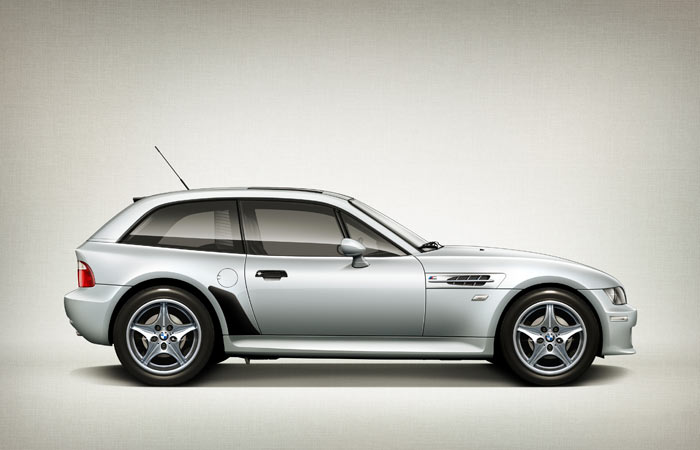
2001 BMW M Coupe
The S54 M Coupe. The rarest car BMW has produced in decades.
For the USA, there were 2,180 M Coupes built with the S52 motor and 690 with the S54 motor for a total of 2,870 models. There were also 3,448 M Coupes built for non-USA markets. World wide, the grand total is 6,318 units.
What makes this car special you ask?
Its the fastest car BMW has ever produced (up to that date). Its been called names, and it seems to be the black sheep of the BMW family. It never received a marketing push from BMW, it was relegated to sell itself on its own merrits. Of the 2870 M coupes that were produced from 1998-2002, only 690 were produced with the S54 Engine from the E46 M3. In this much smaller and more agile car, we find it is a brutal combination.
The M coupe was designed by a team of engineers in the basement of some hall somewhere in Germany. Its one purpose was to be the track. The design was by engineers, and is free from the quirky and awkward styling of the current range of Bimmers. Form follows function on the M coupe, and because of this its design is at best polarizing among those who actually know what it is.
History.
What makes the M coupe unique?
The M coupe is the BMW M-developed version of the Z3 coupe. It uses one of three 24-valve six-cylinder engines originally developed by BMW M for the E36 M3 and E46 M3. It also has an M-tuned chassis and several unique cosmetic parts.
Where was the M coupe first introduced?
The M coupe was first unveiled at the 1997 Frankfurt motor show, though production did not begin until the following year.
Where was the M coupe produced?
Like all Z3-based cars, every M coupe was assembled at the Spartanburg, South Carolina factory. The drivetrain was assembled in Germany and mated with the rest of the car at Spartanburg.
What’s the story behind the M coupe’s development?
The M coupe was developed under the leadership of engineer Burkhard Goschel with the intention of adding increased torsional and structural rigidity to the Z3 roadster’s chassis. The development team had a hard time convincing the Board of Directors to approve the model for production, but it was eventually given the green light as long as it remained cost-effective to produce. To achieve this goal, as many body panels as possible had to be shared with the roadster, thus the doors and everything from the A-pillar forward are interchangeable between the coupe and roadster, as are most interior parts. The Z3 coupe, which mates the M coupe’s body with the standard Z3 drivetrain, chassis and cosmetics was approved for production at the same time.
Production Data.
How many versions of the M coupe are there?
The original M coupes, with engines from the E36 M3, were built through June of 2000 in three different versions: European-specification (S50 engine) in both left- and right-hand drive, and North American-specification (S52 engine) in left-hand drive. After having been discontinued for more than six months, a revised M coupe entered production in February, 2001. All three versions (European-spec/LHD, European-spec/RHD and North American-spec) utilize the S54 motor from the E46 M3.
How many of each version were produced?
ECE S50 (LHD): 2,178 built from 04/98 thru 06/2000
ECE S50 (RHD): 821 built from 08/98 thru 06/2000
NA S52 (LHD): 2,180 built from 07/98 thru 06/2000
ECE S54 (LHD): 281 built from 02/2001 thru 05/2002
ECE S54 (RHD): 168 built from 02/2001 thru 05/2002
NA S54 (LHD): 690 built from 02/2001 thru 05/2002
What changed during the production of the original (S50 and S52-powered) M coupe?
The following items were introduced or modified during the several years that the S50- and S52-powered M coupes were produced:
Chrome slats added to front “kidney” grilles (4/99 production).
Chrome headlight surrounds added (4/99 production).
Central locking upgraded to include the fuel door (4/99 production).
Airbags upgraded to two-stage “smart” versions (4/99 production).
Titanium Silver metallic (354) introduced in place of Arctic Silver metallic (309) (4/99 production).
Oxford Green II metallic (430) introduced in place of Boston Green metallic (275) (4/99 production).
What changes were made to the M coupe starting with February, 2001 production?
The updated M coupe entered production in February, 2001 with the following changes:
More powerful and advanced S54 engine (developed for the E46 M3).
3.15:1 final drive for all markets.
Dynamic Stability Control (DSC).
Low tire pressure monitoring system.
Revised gauges with gray backgrounds.
Reshaped rearview mirror with auto-dimming and chrome surround (in some markets).
Curved exterior M badges.
RoadStar alloy wheels with Chrome Shadow finish.
Evergreen (358), Dakar Yellow II (337) and Cosmos Black metallic (303) paints discontinued.
Laguna Seca Blue (448), Phoenix Yellow metallic (445), Steel Gray metallic (400) and Black Sapphire matallic (475). paints introduced.
Evergreen/Black and Kyalami Orange/Black interiors discontinued.
Laguna Seca Blue/Black interior introduced.
What are the differences between a U.S.-spec M coupe and a Canadian version?
Aside from minor changes to the instruments and controls (daytime running lights, metric instrumentation, etc.) and slight differences in equipment (such as optional headlight washers), the Canadian M coupe is identical to the U.S. model.
Drivetrain.
How do the original European-spec and North American-spec M coupes differ mechanically?
BMW M developed two versions of the original M coupe, one for the European market (in both left- and right-hand-drive) and one for the North American market. The European-spec model is fitted with the 321-hp (DIN) S50 B32 powerplant, as used in the European version of the E36 M3. North American-spec M coupes utilize the 240-hp (SAE) S52 engine, as found in the North American iteration of the E36 M3. Both versions have identical ZF five-speed manual gearboxes, but the North American version is the only one fitted with BMW’s ASC+T traction control system. Also, the European-spec M coupe is electronically governed to 155 mph, while the North American version is limited to 137 mph.
What are the differences between the S50 and S52 engines?
The North American-spec powerplant, known as the S52, is based closely on the regular production M52 engine. Like that motor, the S52 is a six-cylinder with a cast iron block, aluminum head and four valves per cylinder, with two-stage VANOS variable valve timing on the intake strokes. Unique to the S52 is a bore of 86.4mm and stroke of 89.6mm for a total displacement of 3,152cc. The engine is rated at 240 hp (SAE) at 6,000rpm and 236 lb/ft of torque at 3,800 rpm.
In addition to the larger displacement, the S52 utilizes the following special M components:
Ported and polished cylinder head.
Retuned VANOS variable valve timing for greater high-rpm power.
Heavy-duty valve springs.
More finely balanced camshafts.
Valve lifters, springs and spring seats with reduced mass.
Free-flowing intake and exhaust systems.
The European-spec powerplant, known as the S50 B32, is a much more exotic unit. With a bore of 86.4mm and a stroke of 91mm, the S50 B32 has a total displacement of 3,201cc. Like the S52, it has an iron block and aluminum head with four valves per cylinder. However, the S50 B32 incorporates the following special features to allow it to produce an impressive 321 hp (DIN) at 7,400rpm and 258 lb/ft of torque at 3,250 rpm:
Individual throttle plates for each cylinder.
Increased compression ratio to 11.3:1.
Advanced BMW/Siemens MSS50 engine management system able to compute 20 million instructions per second.
Double VANOS continuously variable valve timing on both intake and exhaust strokes.
Lightweight pistons.
Dual-mass flywheel.
Graphite-coated conrods.
Larger inlet valves.
Second oil pump.
What are the differences between the S50 and S54 engines?
The S54 powerplant of the later M coupes is technically an evolution of the iron-block S50 B32 unit used in all European-spec M coupes built through June of 2000. Although the peak power and torque of the S54 (325 hp at 7,400 rpm and 261 lb/ft of torque at 4,900 rpm) are barely increased compared to the S50 B32 (321 hp at 7,400 rpm and 258 lb/ft of torque at 3,250 rpm), they share few major components and differ in many areas including:
Increased cylinder bore to 87mm (from 86.1mm) for a new total displacement of 3,246cc (from 3,201cc).
Modified camshafts.
High pressure Double VANOS continuously variable valve timing system with faster operation at high rpm.
Increased compression to 11.5:1 (from 11.3:1).
More advanced BMW/Siemens MSS 54 engine management control.
Finger-type rocker arms for reduced reciprocating mass and friction.
One-piece aluminum head casting for lighter weight.
Scavenging oil pump to maintain pressure during heavy cornering.
The S50 B32 unit can be is identified by the “BMW M Power” inscription on its cam cover, while the S54 version contains only the “M” badge.
Aside from the S54 engine, how is the drivetrain of the revised M coupe altered?
The other major addition to the revised M coupe is an M-tuned version of Dynamic Stability Control (DSC) for all markets. An evolution of Automatic Stability Control plus Traction (ASC+T), DSC compensates for oversteer and understeer through manipulation of each individual brake as determined by sensors measuring steering angle, vehicle speed, cornering force, brake pressure and the vehicle?s rotation around its vertical axis. The system is fully integrated with the BMW/Siemens MSS 54 engine management control, and its intervention can be reduced or completely eliminated via a console-mounted button.
How do the revised European-spec and North American-spec M coupes differ mechanically?
All of the updated M coupes sold worldwide are powered by the S54 engine, as used in the E46 M3. European-spec versions are rated at 325 hp (DIN), while North American versions produce 315 hp (SAE), which translates to about 320 hp (DIN). The small loss in power can be attributed to the more restrictive placement of the catalysts on North American-spec cars in order to improve cold-start emissions. All S54-powered M coupes have an electronically-limited top speed of 155 mph (earlier M coupes were limited to 137 mph for North America) but only the Euro-spec cars have the two-piece “floating” brake rotors.
What kind of gearbox does the M coupe have?
All M coupes use the ZF Type C five-speed manual gearbox with the following ratios: 4.21 (1), 2.49 (2), 1.66 (3), 1.24 (4), 1.00 (5). The final drive is either 3.23:1 (S52) or 3.15:1 (S50 and S54). A limited slip differential with a maximum locking of 25 percent is standard.
Chassis.
How is the M coupe’s chassis different from that of the standard Z3 coupe?
Like all Z3s, the M coupe’s suspension is made up of MacPherson struts in the front and semi-trailing arms in the rear. However, compared to the Z3 coupe, the M coupe has the following modifications:
Wider front and rear tracks (by 0.4-inches).
Reduced ride height (by 1.1-inches).
Modified front suspension geometry.
Firmer springs and shocks.
Thicker anti-roll bars.
Stronger semi-trailing arms.
Reinforced subframe.
How much stiffer is the M coupe compared to the M roadster?
The M coupe has a static structural stiffness of 16,400 Newton-meters per degree of twist, which is 2.6 times as twist-resistant as the roadster. BMW claims this makes the structural stiffness higher than any other model it has ever produced. Dynamic stiffness is rated at 29.2 Hz, the same as an E36 M3 coupe.
How is the M coupe’s chassis different on the S54-powered model?
There are no chassis differences between the original M coupe and those with the later S54 engine.
What size brakes does the M coupe have?
The M coupe adopted the brakes from the contemporary E36 M3, four-wheel vented discs measuring 12.4-inches in the front and 12.3-inches in the rear. In addition, European-spec cars have two-piece “floating” front rotors.
Why was the North American market denied the “floating” rotors?
The North American market was denied the more efficient two-piece rotors of the Euro-spec M roadster because BMW of North America was concerned that, if not properly maintained, the rotors presented the possibility of failing, thus creating a legal liability.
What are the factory wheel and tire sizes?
All M coupes use the same size tires (225/45ZR17 in the front and 245/40ZR17 in the rear) and one of two versions of the five-spoke “M RoadStar” alloy wheels. Both styles are sized 7.5×17-inch (front) and 9×17-inch (rear), but on early M coupes (S50 and S52 engines) they have a Chromeline finish, while the later models (S54 engine) utilize a Chrome Shadow finish.
Cosmetics.
What distinguishes an M coupe cosmetically from a normal Z3 coupe?
The M coupe is based on the Z3 coupe body, but adds a more aggressive front fascia with brake cooling ducts in place of foglights, unique side gill vents with the M logo, chrome windshield washer nozzles, curved M side-view mirrors, a lower rear bumper with four exposed exhaust tips and a relocated rear license plate (located between the taillights instead of within the bumper).
What differentiates the exterior of an S54-powered M coupe from the earlier model?
The exterior of the S54-powered M coupe shares all of its body panels with that of the earlier version. Only the curved M badges and RoadStar alloy wheels with Chrome Shadow finish are unique to the newer model. It is also available in several exterior colors shared with the E46 M3: Laguna Seca Blue (448), Steel Gray metallic (400) and Phoenix Yellow metallic (445).
How is the North American-spec M coupe cosmetically different from the European version?
The North American-spec version of the M coupe is cosmetically very similar to the European version, but can be identified by its amber side marker lights in the front bumper, “free form” headlights in place of the ellipsoid units and twin side-mounted rear license plate illumination lights instead of the single bumper-mounted design.
What distinguishes an M coupe’s interior from that of a normal Z3 coupe?
The interior of the M coupe features several unique items including a chrome-ringed instrument cluster with red needles and the M logo, three auxiliary chrome-ringed gauges in the center console, power and heated sport seats with special pleated leather trim (monotone black or two-tone), a 375mm three-spoke M steering wheel with tri-color stitching, an illuminated M leather shift knob with the M logo on the shift pattern and a chrome boot surround, an oval-shaped rear-view mirror, leather door pulls and center console trim, chrome inside door handles, and door sill plates with the “M” logo.
What differentiates the interior of an S54-powered M coupe from the earlier model?
The most significant alteration to the interior of the revised M coupe is the addition of grey-faced gauges. In some markets, there is also a smaller auto-dimming rear-view mirror with chrome surround. Finally, two interior color combinations (Evergreen/Black and Kyalami Orange/Black) are discontinued on the newer model, while the Laguna Seca Blue/Black combination is available.
How are the European-spec and North American-spec M coupe interiors different?
The interior of all M coupes are essentially identical except for the instruments. In the main cluster, early Euro-spec cars have a 280 kph/170 mph speedometer and a tachometer that reflects the S50 engine’s 7,200-rpm redline, while North American models have a 160-mph/260 kph speedometer and a tachometer with a redline graduated between 6,500 and 7,000 rpm to reflect the S52 engine’s variable redline. In the center console, European models have an outside temperature gauge instead of the voltmeter used in North American editions. The later S54-powered M coupes all have essentially the same grey-faced instruments, including a 280 kph/170 mph speedometer and an outside temperature gauge (Fahrenheit on U.S. models, Celsius for all others).
All M coupes sold in North America are equipped with cruise control and the Harmon/Kardon audio system, optional features in some other markets.
What are the factory options for the M Coupe?
Compared to other M models, there are only slight variations in standard and optional equipment for the M coupe, depending on the market and production date. Because all M coupes have leather upholstery, air conditioning, power seats with two-stage heating and a rear partition net and cargo cover, the list of options is short. In general, it includes cruise control (standard in some markets), a tilting glass moonroof and various audio systems.
(pictures and texts are copyrights to BMW Registry and other pictures are copyrights of their respective companies and authors.)
(source: Z3 M Coupe)

2001 BMW M Coupe.

2001 BMW M Coupe.

2001 BMW M Coupe.

2001 BMW M Coupe.

2001 BMW M Coupe.

2001 BMW M Coupe.

2001 BMW M Coupe.

2001 BMW M Coupe.

2001 BMW M Coupe.

2001 BMW M Coupe.

2001 BMW M Coupe dimensions.
[youtube=http://www.youtube.com/watch?v=4FfliuoUZQY]